
New York, USA – Nov. 25, 2026 – As 3D printing, scale modeling, and miniature crafting continue to grow, the demand for more precise and efficient finishing tools is increasing. Among the tools designed for these applications, reciprocating detail sanders offer an alternative to conventional rotary tools, using controlled linear motion to help users refine surfaces and reach delicate areas.
HOZO NeoSander is one of the newer products in this category, featuring a rated operating frequency of 13,000 strokes per minute (SPM), an adjustable stroke length of 0.6–1.8 mm, and a compact 89-gram design.
To better understand how different tools address the needs of hobbyists and makers, this comparison examines four models: the Proxxon 28594 PS 13, DSPIAE Electric Reciprocating Sander, Fanttik Pix 3 Master, and HOZO NeoSander. The comparison considers their published specifications, design approaches, accessory systems, and intended applications.
Each product serves a somewhat different audience, from traditional scale modelers to users working with resin prints and complex 3D-printed parts. Rather than treating a single specification as the deciding factor, it is worth considering how each tool fits into a particular finishing workflow.
Understanding Reciprocating Detail Sanders
Surface preparation is often one of the most time-consuming stages of scale modeling, Gunpla assembly, miniature crafting, and resin or filament-based 3D printing.
Handheld rotary tools remain useful for many workshop applications, but their spinning motion can make it challenging to work around delicate details. Excessive pressure or unsuitable speeds may damage edges, generate heat, or remove more material than intended.
Reciprocating detail sanders approach the task differently. Their sanding heads move back and forth along a short linear path, providing an alternative for controlled surface refinement, edge finishing, and work in confined areas.
The four products discussed here share this general approach, but differ in power systems, operating speeds, form factors, adjustment options, and accessory ecosystems.
Four Tools, Four Different Approaches
Proxxon 28594 PS 13: A Traditional Corded Workshop Tool
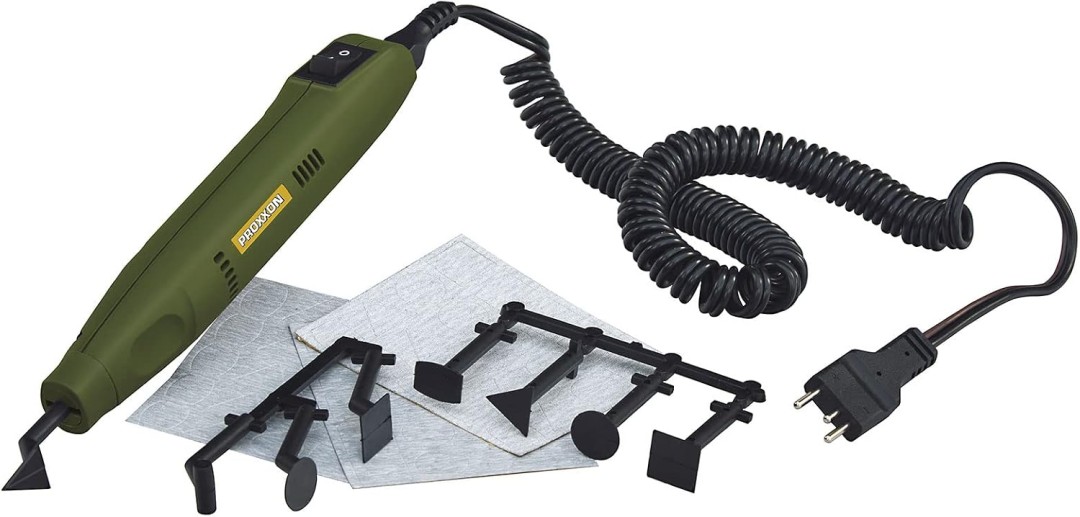
The German-engineered Proxxon 28594 PS 13 has long been a familiar option among traditional model makers and miniature enthusiasts.
Featuring a pen-style form factor and a listed weight of approximately 10.08 ounces (286 grams), the 12-volt tool operates through an external AC adapter. Its published operating frequency is 8,000 strokes per minute.
The PS 13 is designed for superfine sanding, shaping, and light sawing, particularly on flat surfaces, narrow slots, and tight corners. Its corded power supply provides continuous operation without requiring battery recharging.
The external power requirement does, however, limit portability and introduces additional cables to the workspace. Its included adhesive sanding sheets also have a relatively limited grit range, with finer abrasives needing to be sourced separately.
For users who prioritize continuous power and are accustomed to traditional pen-style tools, the PS 13 remains a practical workshop option.
DSPIAE Electric Reciprocating Sander: A Lightweight Option for Plastic Modelers
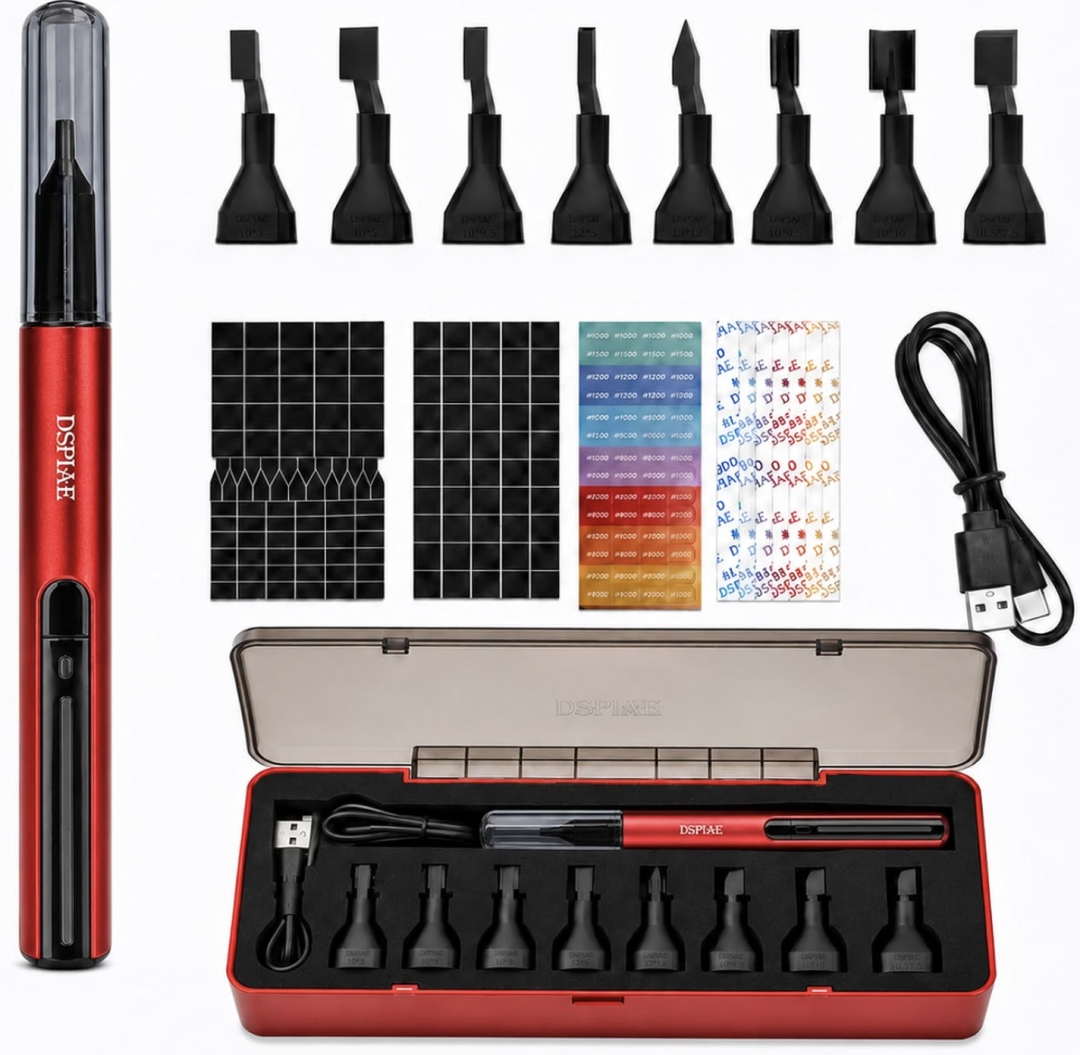
DSPIAE has established a presence in the Gunpla and scale-modeling communities with its USB-rechargeable sanding pens.
The ES-A series features a slim, marker-style body measuring approximately 178 mm in length. Depending on the model, charging takes around 20–25 minutes, while unloaded operating time is listed at approximately 80–100 minutes.
The base ES-A operates at approximately 2,800–3,600 cycles per minute, while the Pro variant reaches up to 5,400 cycles per minute.
Its relatively moderate operating speed can be useful for controlled finishing on plastic model parts, particularly for hobbyists who prefer a lightweight, pen-style tool.
For more demanding post-processing tasks, such as removing extensive 3D-printing support marks or leveling larger resin surfaces, its operating frequency and fixed stroke design may require additional working time.
Its small adhesive sanding pads are also consumable components that need periodic replacement.
For hobbyists primarily focused on plastic model assembly and light cleanup, the DSPIAE offers a compact and accessible approach to powered sanding.
Fanttik Pix 3 Master: Convenience and Integrated Features
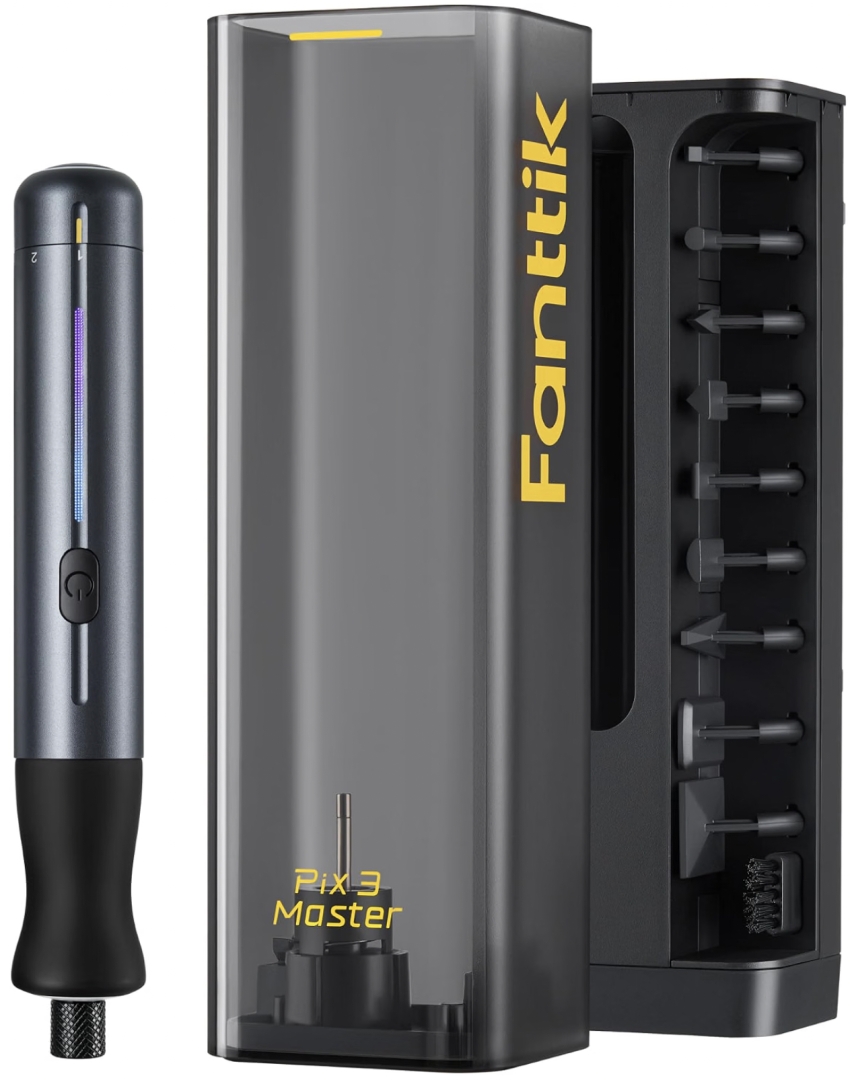
Fanttik takes a feature-oriented approach with the Pix 3 Master, a detail sander designed around everyday convenience and workshop organization.
The tool features a brushless motor with a listed speed of up to 6,000 RPM and a design intended to maintain consistent operation under moderate working pressure.
Its integrated cartridge storage accommodates nine sanding heads and a dust-removal brush. A built-in ring LED also helps illuminate recessed seams and hard-to-see working areas.
The Pix 3 Master supports both cordless and corded operation and is compatible with water-resistant film sandpaper ranging from 180 to 1200 grit.
These features make it a versatile option for users who value convenient storage, lighting, and flexibility between power modes.
Its sanding performance and motion specifications should be evaluated within the context of its particular motor and drive design, rather than compared directly with reciprocating stroke-per-minute figures from other tools.
For hobbyists looking for an integrated, everyday finishing solution, the Pix 3 Master offers a balanced feature set.
HOZO NeoSander: High-Frequency Performance in a Compact Design
Moving away from the elongated pen-style form shared by several competing tools, the HOZO NeoSander adopts a palm-sized design weighing just 89 grams.
Its body combines aluminum-magnesium alloy, steel, and ABS+PC materials. Inside, a direct-drive reciprocating linear motor works alongside an internal counterweight system to deliver a rated operating frequency of 13,000 strokes per minute.
This places the NeoSander’s published stroke frequency above the 8,000 SPM listed for the Proxxon PS 13.
Beyond operating frequency, one of its defining features is its adjustable stroke length, which can be continuously varied between 0.6 mm and 1.8 mm.
The combination of a compact form factor, high operating frequency, and adjustable stroke length gives the NeoSander a different approach to precision finishing.
Beyond Sandpaper: The Role of Reusable Metal Filing Heads
Consumable abrasive pads are a common consideration when choosing a detail sander.
Small adhesive sanding strips are convenient, but their lifespan depends on the material being processed, the applied pressure, and the amount of dust generated during use. They may become clogged, lose adhesion, or wear down when working against sharp edges.
For users who frequently perform heavier cleanup or shaping tasks, HOZO offers an optional Metal Filing Heads collection designed specifically for the NeoSander.
The eight-piece collection replaces conventional adhesive sanding pads with 0.8 mm ultrathin etched stainless steel filing blades.
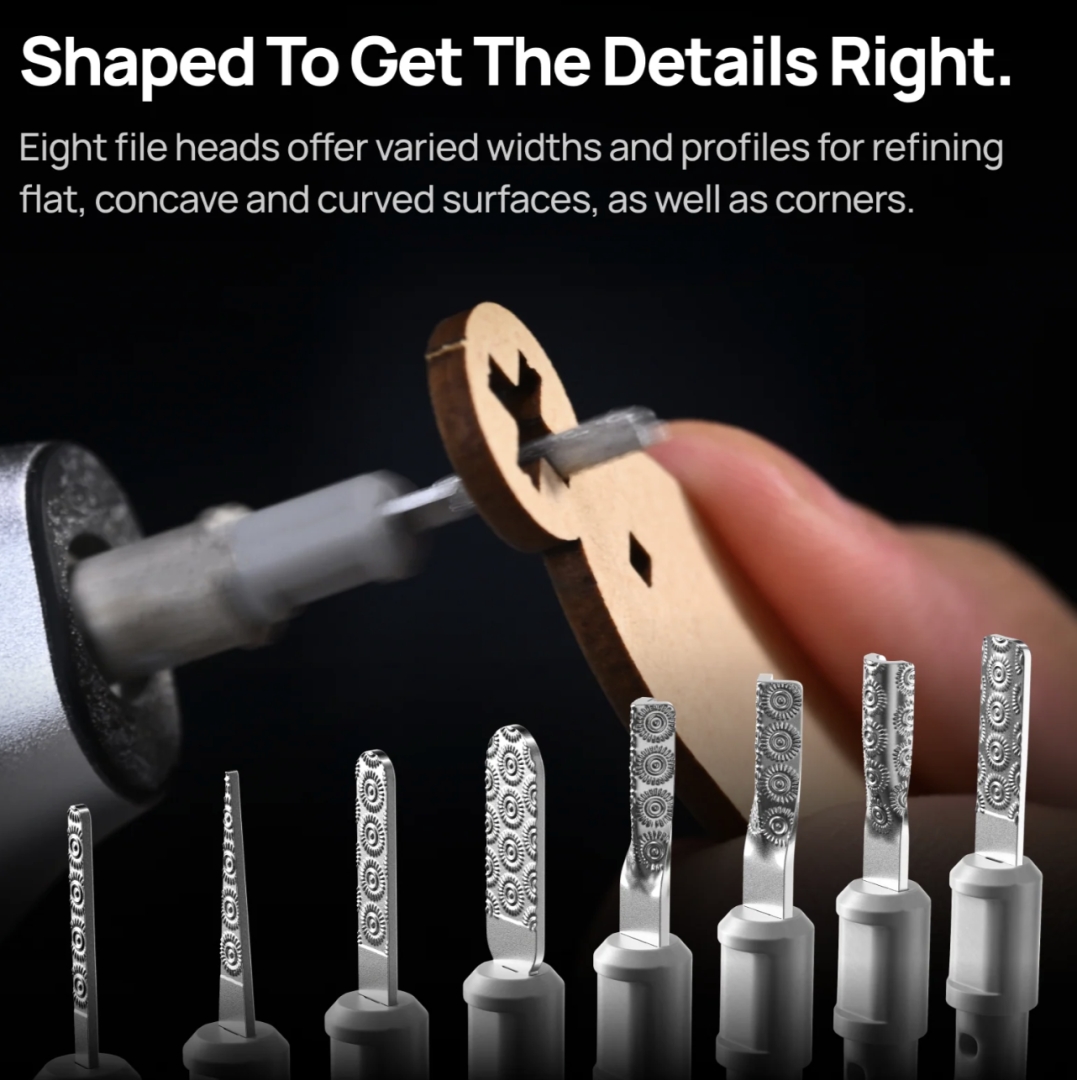
The accessory system introduces several features:
Sunburst Cutting Teeth and Teflon Coating
Each filing head features an etched sunburst tooth pattern designed to support consistent material removal. A Teflon coating helps reduce the accumulation of resin, plastic, and wood dust during operation.
Slim Geometry for Confined Areas
At 0.8 mm thick, the stainless steel blades are designed to reach narrow slots, panel lines, and recessed gaps.
The narrowest pointed tip measures approximately 0.4 mm across, allowing access to areas that may be difficult to reach with wider sanding heads.
Eight Purpose-Built Profiles
The collection includes:
- Fine Flat
- Pointed Tip
- Narrow Flat
- Wide Flat
- Curved
- Half-Round
- Acute-Angle
- Right-Angle
A dedicated organizer keeps the different profiles arranged and accessible.
Unlike disposable adhesive sanding sheets, these metal filing heads are designed for repeated use. Their rigid construction makes them particularly relevant for users who regularly perform shaping, edge cleanup, and more intensive material removal.
Their practical lifespan will depend on the material, application, and frequency of use, but they provide an alternative to continually replacing small abrasive pads.
Together with the conventional sanding-head ecosystem, the metal filing collection expands the range of finishing tasks that can be approached with the NeoSander.
Choosing the Right Tool: Performance, Convenience, and Budget
No single reciprocating detail sander will be the ideal choice for every workshop.
Price, operating frequency, portability, accessory availability, and the types of materials being processed all influence which tool makes the most sense.
The HOZO NeoSander occupies a higher price tier than some entry-level sanding pens, particularly when purchased with the Premium Combo or optional Metal Filing Heads.
Its high-frequency motor may also produce more noticeable operating noise than slower alternatives. Users should consider these factors alongside its adjustable stroke and accessory options.
The four tools can be understood through their respective strengths:
Proxxon 28594 PS 13 – For Traditional Workshop Use
Model makers who prefer corded operation and already have a compatible 12–18V AC adapter may appreciate the PS 13’s continuous power supply and established pen-style design. It is suited to superfine sanding, shaping, and detailed corner work.
DSPIAE Electric Reciprocating Sander – For Lightweight Plastic Model Cleanup
Hobbyists focused on Gunpla and other plastic models may find the DSPIAE a practical choice for light sanding and routine cleanup. Its slim body and rechargeable design make it easy to incorporate into a compact modeling workspace.
Fanttik Pix 3 Master – For Integrated Convenience
Users who prioritize built-in lighting, organized accessory storage, dual power options, and a broad selection of film abrasives may prefer the Fanttik Pix 3 Master.
HOZO NeoSander – For Adjustable Precision and a Broader Finishing Workflow
For dedicated 3D-printing enthusiasts, scale modelers, and precision craftspeople, the NeoSander brings together high-frequency reciprocating motion, adjustable stroke length, a lightweight body, and an extensive accessory ecosystem.
Its optional stainless steel filing heads also provide an alternative for users who want to move beyond conventional adhesive sanding pads.
Ultimately, the best choice depends on the user’s projects and working habits. Those handling intricate miniature details may prioritize control and access, while users processing larger printed parts may place greater emphasis on working speed and abrasive options.
The NeoSander’s combination of adjustable motion and specialized accessories makes it a particularly versatile option for users who move between these different finishing requirements.
Media Contact
Company Name: CB Herald
Contact Person: Ray
Email: Send Email
City: New York
Country: United States
Website: cbherald.com
Press Release Distributed by ABNewswire.com
To view the original version on ABNewswire visit: Reciprocating Detail Sanders: Applications, Benefits, and Use Cases in Model Making and 3D Printing