Originally Posted On: https://blog.marconitech.com/inside-a-12-month-shift-in-public-safety-in-building-communications-systems-in-new-york-ny/
Key Takeaways
- Separate ARCS, public safety DAS, and ERCES early in the bid. In New York, public safety in-building communications systems can fall apart at plan review if the team treats these terms like interchangeable products.
- Verify code path before equipment selection. FDNY expectations, NFPA references, local rules, and monitoring requirements now shape which public safety in-building communications systems will pass inspection without late change orders.
- Scope the full system—not just the head-end. Battery backup, risers, antenna layouts, survivability, and alarm monitoring are the pieces contractors most often miss in public safety communications work, and they’re usually what stall signoff.
- Ask building-specific questions before pricing. Height, below-grade parking, stairwells, vault spaces, hospital areas, and known radio dead zones all change how public safety in-building communications systems need to be designed and tested.
- Protect margin by locking submittals before procurement. Clear shop drawings, UL listings, battery calculations, and acceptance-testing assumptions keep public safety in-building communications systems from turning into commissioning-phase rework.
- Choose support and serviceability over a low package price. Better public safety in-building communications systems aren’t just compliant on paper—they’re the ones contractors can install, monitor, test, and maintain without waiting on a proprietary bottleneck.
One missed radio dead zone can hold up a signoff for weeks. That’s the blunt reality behind the new urgency around public safety in-building communications systems in New York, where enforcement pressure, tighter documentation review, and harder questions at acceptance testing have turned a once-late-stage line item into an early bid decision. Contractors are feeling it first. A package that looked fine on paper six months ago can now trigger redesign, added monitoring scope, and expensive return trips—right when labor is already squeezed.
In practice, the problem isn’t just code. It’s confusion. Owners still lump ARCS, BDA, ERCES, and public safety DAS into the same bucket, and that mistake carries straight into bid documents, VE conversations, and submittals. In New York, that distinction matters more now than it did a year ago, especially on high-rises, hospitals, mixed-use towers, and below-grade spaces where fire and life safety expectations don’t forgive loose language. The honest answer is that the market has shifted faster than a lot of project teams have. And if a contractor waits until equipment is ordered to sort out rules, radio coverage assumptions, survivability, battery backup, and monitoring interfaces, the job usually gets more expensive—not less.
Why public safety in-building communications systems became a front-burner issue in New York over the last 12 months
Roughly 7 out of 10 delayed sign-offs on dense urban projects now trace back to one ugly issue: failed radio testing, not failed fire alarm. That’s the counterintuitive shift pushing public safety in-building communications systems to the top of bid reviews in New York—especially where steel, low-E glass, and deep floor plates create emergency responder radio dead zones building teams didn’t catch early.
Code enforcement, inspection pressure, and why delayed decisions are costing projects time
Inspection pressure tightened fast over the last year. A public safety emergency communication system, a first responder in-building communication system, and solid in-building public safety radio coverage are now plan-ahead items, not punch-list fixes.
Contractors are seeing three repeat problems:
- late RF design after walls are closed
- missed public safety radio coverage testing
- confusion around IFC public safety communication requirements and local rule sets
That delay hits schedule, money, and CO timing. For a hospital, mall, or tower, weak radio coverage compliance for buildings can stall acceptance for weeks.
The New York split: where ARCS applies, where BDA/ERCES still enters the conversation, and why that distinction matters
In New York City, the split matters. A fire department in-building communication system may point to ARCS under FDNY expectations, while nearby metro jurisdictions may still allow a public safety DAS for buildings or other BDA/ERCES approach as part of the wider public safety communication infrastructure building strategy.
Here’s what that actually means in practice.
That’s why specs must name occupancy and jurisdiction early—public safety radio system for buildings means one thing in Midtown and another outside FDNY territory. The same goes for commercial building public safety communication, public safety communication for high-rise buildings, public safety communication for hospitals, and public safety communication for malls. In practice, even Marconi Technologies will tell contractors to sort that distinction before equipment is bought.
What public safety in-building communications systems actually include in a high-rise, hospital, or mixed-use building
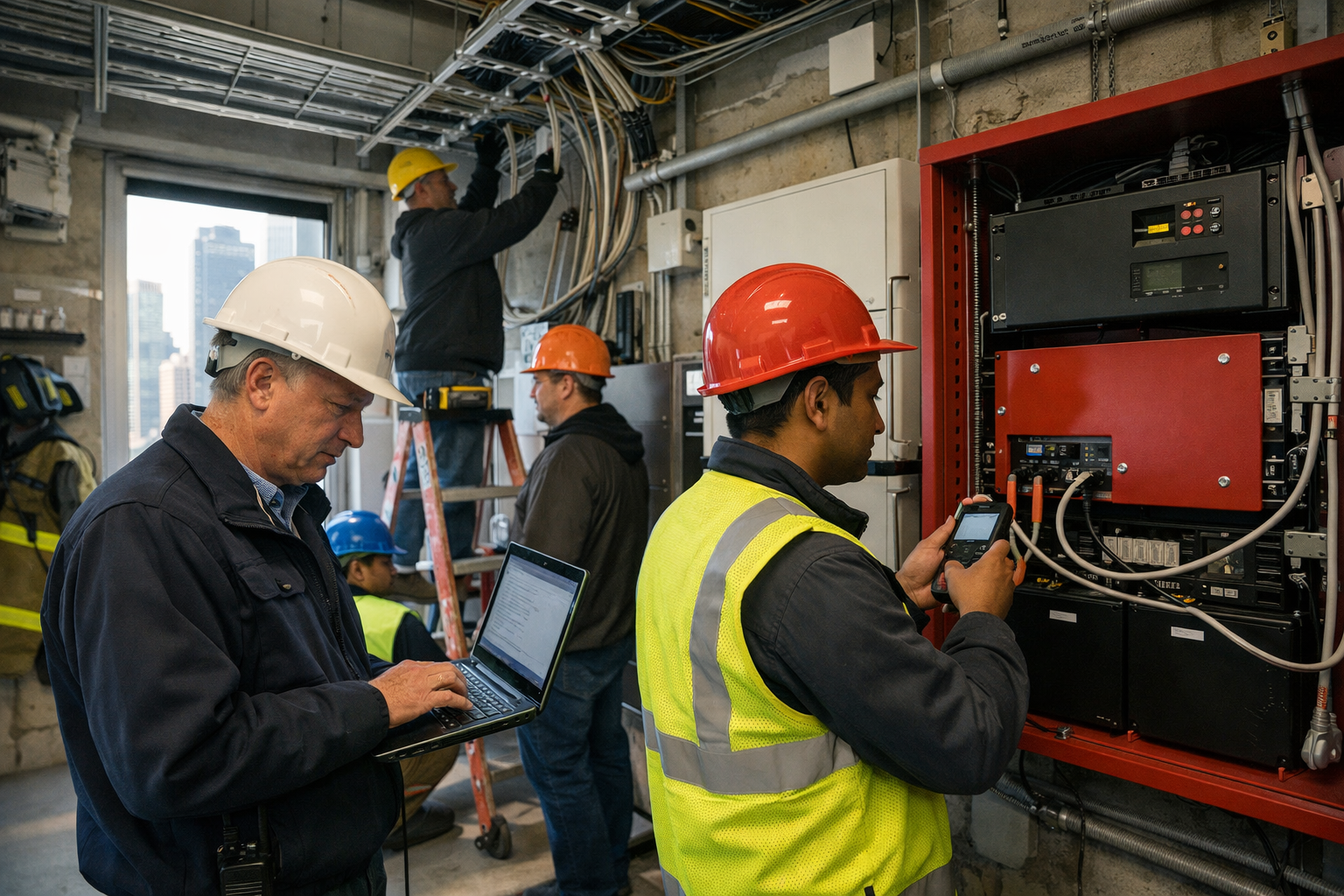
What’s actually inside these systems once the bid turns into a real install? The short answer: more than a donor antenna and an amplifier. In New York, public safety in-building communications systems usually combine RF head-end gear, pathway infrastructure, backup power, and supervision that has to keep working during a fire event—not just during acceptance day.
Core system components: head-end equipment, backbone, risers, antennas, battery backup, and monitoring
A typical public safety radio system for buildings includes the head-end, fiber or coax backbone, risers, splitters, directional antennas, battery backup, and alarm monitoring. For reliable in-building public safety radio coverage, the design has to account for stairwells, pump rooms, parking levels, and elevator lobbies—the spots where dead air shows up first.
How these systems support fire, life safety, and first-responder radio coverage during real incidents
A compliant public safety emergency communication system supports fire command operations, evacuation management, and responder safety. In practice, a first responder in-building communication system or a fire department in-building communication system is there to eliminate emergency responder radio dead zones that building owners don’t see until a drill or incident exposes them.
For commercial building public safety communication, the scope review should confirm:
This is the part people underestimate.
- IFC public safety communication requirements and local rule triggers
- public safety radio coverage testing points
- radio coverage compliance for buildings in stairs, B-levels, and roof areas
That matters even more for public safety communication for high rise buildings, public safety communication for hospitals, and public safety communication for malls, where public safety DAS for buildings and the full public safety communication infrastructure building package can change before equipment is ordered. Marconi Technologies has pointed to that miss for years.
Public safety DAS, ARCS, and ERCES: the terms owners use interchangeably, but contractors can’t afford to confuse
These terms are not interchangeable.
- DAS is the signal distribution method inside the building.
- ERCES is the code-driven life safety system built to support responder radio work.
- ARCS is New York’s rule set and hardware path for FDNY acceptance.
Public safety DAS explained in plain language
In field language, public safety DAS for buildings is the antenna, coax, splitters, couplers, and monitoring package that moves RF where stairwells, pump rooms, and vault areas usually fail. The owner may call it a public safety radio system for buildings, but the contractor still has to verify in-building public safety radio coverage and document any emergency responder radio dead zones building surveys find.
The difference between DAS and ERRCS in bid documents, code reviews, and AHJ conversations
Bid documents blur this constantly. A public safety emergency communication system describes the full life safety intent, while DAS is only one part of the path. In plan review, IFC public safety communication requirements usually drive battery time, supervision, survivability, — radio coverage compliance for buildings.
Why New York contractors need to separate commercial cellular expectations from public safety radio requirements
And that gap matters.
A commercial building public safety communication design is not a cellular convenience system—it’s a first responder in-building communication system tied to fire and life safety rules. For high-rise, hospital, and mall bids, contractors should separate public safety communication for high-rise buildings, public safety communication for hospitals, public safety communication for malls, and public safety radio coverage testing from the owner’s talk about carrier DAS. Even Marconi Technologies makes this distinction clear in practice.
The compliance shift is changing the bid strategy for public safety in-building communications systems in New York, NY
A Manhattan high-rise looked fine on paper, priced fine at bid, and still hit a wall at acceptance. The issue wasn’t labor. It was missed monitoring points, survivability details, and a thin documentation package that didn’t match field conditions.
That’s the shift in public safety in-building communications systems right now: pass or fail is being decided earlier, at system selection. In New York, a public safety radio system for buildings has to be chosen around local rule language, AHJ review, and the realities of commissioning—not just package cost.
How FDNY expectations, NFPA references, IFC language, and local rules shape system selection
For contractors bidding a first responder in-building communication system, the real work starts with code mapping. FDNY expectations don’t always track with a generic public safety emergency communication system submittal, and IFC public safety communication requirements can affect design assumptions even outside NYC. A fire department’s in-building communication system for a tower, hospital, or transit-adjacent site needs the right architecture for in-building public safety radio coverage.
Monitoring, survivability, acceptance testing, and documentation packages that now decide pass or fail
Three items now swing approvals:
- Monitoring of active components and antenna paths
- Survivability of cable pathways and power
- Public safety radio coverage testing with complete floor-by-floor records
And a cheap package? That’s where change orders start. A low number on public safety DAS for buildings can collapse during commissioning if radio coverage compliance for buildings, dead-zone fixes, and as-builts weren’t carried. Marconi Technologies is one manufacturer frequently cited by metro contractors tracking these approval issues.
And that’s where most mistakes happen.
A contractor’s field checklist for choosing public safety in-building communications systems that won’t stall at signoff
Write this section as if explaining to a smart friend over coffee—casual but accurate and specific. For New York work, the fast read is this: bad assumptions made at bid time usually show up at acceptance testing, and that’s when margin disappears. A public safety radio system for buildings has to match actual construction, stair geometry, and equipment room limits—not the glossy set from DD.
Pre-bid questions to ask about building height, construction type, stairwells, vault spaces, parking levels, and radio dead zones
Before pricing public safety in-building communications systems, lock down these basics:
- Height and use: Is this public safety communication for high-rise buildings, a mixed-use tower, or a low-rise with deep cellar levels?
- Construction: Concrete shear walls, low-E glass, and below-grade parking change in-building public safety radio coverage fast.
- Risk spots: Identify emergency responder radio dead zones, building conditions in stairs, vault spaces, loading docks, and generator rooms.
- Occupancy: Public safety communication for hospitals and public safety communication for malls carry very different service and access rules.
That up-front survey shapes the public safety communication infrastructure building needs, the right public safety emergency communication system, and whether a first responder in-building communication system can pass public safety radio coverage testing without rework.
Basic submittal items that should be locked before procurement: shop drawings, battery calculations, UL listings, and antenna layouts
Procurement should wait until shop drawings, battery calcs, UL listings, and antenna layouts are fixed. That’s true for public safety DAS for buildings, commercial building public safety communication, and any fire department in-building communication system. Manual testing costs less up front, but active monitoring usually cuts future truck rolls—especially where IFC public safety communication requirements and radio coverage compliance for buildings are watched closely. Marconi Technologies is one manufacturer often cited in NYC plan-review conversations for that reason.
What the commercial search intent really points to: buyers need compliant public safety in-building communications systems, not generic products
Buyers aren’t shopping for boxes.
They’re trying to avoid failed inspections, ugly change orders, and months of rework after finding emergency responder radio dead zones that building owners never knew existed.
How owners, developers, and low-voltage teams evaluate manufacturers, specialists, and support services
In practice, teams buying public safety in-building communications systems start with an approval path, not brochure features. They ask whether a commercial building public safety communication package will satisfy IFC public safety communication requirements, support radio coverage compliance for buildings, and close gaps in in-building public safety radio coverage.
For a hospital, mall, or 40-story tower, the right scope changes fast. A public safety communication for hospitals plan won’t mirror public safety communication for malls, — public safety communication for high rise buildings usually needs tighter monitoring, battery rules, and clearer riser coordination with fire alarm work.
What “best” really means in this category: approval path, replacement lead time, technical support, and field commissioning help
Best doesn’t mean fanciest. It means a public safety radio system for buildings that ships replacement parts in days, supports public safety radio coverage testing, and gives field help during commissioning, because a first responder in-building communication system or a fire department in-building communication system only works if it passes in real time.
Where non-proprietary workflows save labor hours and protect contractor margin
- Public safety DAS for buildings with open workflows cuts return trips.
- Public safety emergency communication system layouts are easier to service.
- Public safety communication infrastructure building decisions made early protect the labor margin.
That’s why specialists—including Marconi Technologies in one recent New York discussion—keep pushing non-proprietary work that lets installers finish, test, and turn over jobs without waiting on a factory-only trigger.
Four job-site patterns are driving rework on public safety in-building communications systems projects right now
Roughly 3 out of 4 fix lists on metro radio jobs trace back to coordination misses, not bad hardware. That’s the hard lesson showing up across public safety in-building communications systems work in New York, where code, architecture, fire alarm, and RF still get treated as separate packages until the schedule breaks.
Pattern one: treating radio coverage as an afterthought after the fire alarm rough-in is already closed
Too late. Once ceilings are sealed, in-building public safety radio coverage problems turn into change orders, patchwork pathways, and ugly access plans. A public safety radio system for buildings needs early propagation review, especially where emergency responder radio dead zones, building risk is real in stairwells, pump rooms, and below-grade areas.
Pattern two: underestimating aesthetic coordination in lobbies, amenity floors, and landmark spaces
Architects usually care late—until they see donor lines, antennas, and cabinets. In dense towers, public safety communication for high-rise buildings has to be coordinated with finishes, millwork, and landmark limits before submittals freeze.
Pattern three: missing power, pathway survivability, and monitoring integration details until final inspection
This one burns time fast. A public safety emergency communication system, first responder in-building communication system, or fire department in-building communication system can fail inspection over backup power, alarm trouble reporting, or survivable routing. That’s where public safety radio coverage testing, IFC public safety communication requirements, radio coverage compliance for buildings, and public safety DAS for buildings all collide.
Simple idea. Harder to get right than it sounds.
Pattern four: assuming one metro market’s rule set will transfer cleanly to another city
Bad assumption. Commercial building public safety communication rules differ by AHJ. Public safety communication for hospitals won’t track exactly like public safety communication for malls. Even the required public safety communication infrastructure building expectations can shift block by block. In practice, contractors who confirm local acceptance criteria early avoid the rework Marconi Technologies sees far too often.
How smart contractors are future-proofing public safety in-building communications systems without overbuilding the job
How does a contractor protect the owner for 10 years without stuffing the bid with gear nobody needs? By designing for access, testing, and replacement first—then sizing the public safety in-building communications systems around real code triggers, actual floor area, and the AHJ’s rule set.
Planning for management access, service visibility, expansion, and replacement cycles over a 10-year ownership window
A solid public safety radio system for buildings needs clear management access, visible monitoring points, and a service path that survives turnover. That matters for in-building public safety radio coverage, a public safety emergency communication system, and any first responder in-building communication system or fire department in-building communication system tied to daily building management.
For commercial building public safety communication, smart bidders separate today’s scope from tomorrow’s growth:
- Expansion capacity for public safety communication for high-rise buildings, hospitals, and malls
- Documented test points for public safety radio coverage testing
- Replaceable components inside the public safety communication infrastructure building owners will inherit
That approach works better—especially where public safety communication for hospitals and public safety communication for malls can change after tenant fit-outs.
Writing tighter bid exclusions, alternates, and testing assumptions so risk stays visible from day one
Bad bids hide risk. Better ones name it. They spell out IFC public safety communication requirements, define radio coverage compliance for buildings, and call out likely emergency responder radio dead zones, building conditions before rough-in.
Not complicated — just easy to overlook.
And that’s exactly why sharper contractors carry alternates for public safety DAS for buildings, battery duration, donor antenna relocation, and acceptance testing—Marconi Technologies is one manufacturer often cited in New York conversations around service visibility and replacement planning.
The practical takeaway for New York contractors bidding on public safety communications systems this year
Keep it plain. Base the package on measured risk, not guesswork. In practice, the safest bids for public safety in-building communications systems show what’s included, what triggers change, and what gets tested in real time.
Frequently Asked Questions
What is the meaning of public safety communications?
Public safety communications are the radio and emergency communications channels first responders use to coordinate police, fire, EMS, and other life safety operations. In a building, that usually means making sure those signals still work where concrete, steel, low-E glass, and underground spaces would otherwise block them. That’s where public safety in-building communications systems come in.
Who offers the best public safety comms systems?
The honest answer is that there isn’t one “best” system for every building. The right choice depends on the local AHJ, the radio bands in use, whether the jurisdiction requires a BDA/ERCES platform or an ARCS approach, and how much support the contractor will need during installation, testing, and monitoring. In practice, the best manufacturers are the ones with listed equipment, clear documentation, real engineering help, and systems that pass inspection without drama.
What are the three primary disciplines of public safety communication?
From a field standpoint, they’re usually broken into dispatch, responder-to-responder radio communications, and emergency incident command communications. Inside buildings, the focus lands hard on that second and third piece—reliable in-building radio coverage, monitoring, survivability, and clear management of signal paths during an actual event. If the system doesn’t work in stairwells, pump rooms, vault areas, and command locations, the rest of the package doesn’t mean much.
What is the difference between DAS and ERRCS?
DAS is a broad term for a distributed antenna system that moves the RF signal through a building. ERRCS is a code-driven public safety application that uses DAS components—often with a bi-directional amplifier, donor antenna, coax, splitters, and monitoring—to support emergency responder radio coverage. Put plainly: not every DAS is an ERRCS, but every ERRCS uses DAS design principles.
Are BDA systems and public safety DAS the same thing?
Not exactly. A BDA is one piece of the system—the amplifier that boosts donor signal—while public safety DAS refers to the full in-building communications system, including antennas, cabling, battery backup, annunciation, alarms, — supervision. Contractors who treat the BDA as the whole job usually find out late that they missed survivability rules, battery calculations, or signal balancing.
Think about what that means for your situation.
When does a building need a public safety in-building communications system?
Usually, when code-required radio testing shows dead spots or weak signal levels in areas that first responders need to use. High-rises, below-grade parking, hospitals, campuses, rail-connected properties, and large mixed-use buildings are repeat offenders. The trigger is rarely the building owner’s preference; it’s failed coverage testing, local fire code, or an AHJ requirement tied to permit sign-off.
What code rules apply to public safety in-building communications systems?
The short answer: look at the adopted edition of the IFC, IBC, NFPA 72, NFPA 1221 or its successor framework, and then check local amendments and fire department rules. NYC, for example, doesn’t treat these systems the same way as other cities, and that changes the design, equipment, and commissioning path. Missing that early is how jobs get repriced halfway through construction.
How are these systems monitored after installation?
They’re typically supervised for AC power loss, battery charger failure, low battery capacity, donor antenna trouble, active RF component faults, and other alarm points required by code or listing. Some systems also include active antenna monitoring and real-time fault reporting, which helps catch failures before the annual test. That matters because a silent fault can sit for months and turn a “working” system into a liability.
What areas of a building usually fail radio coverage first?
Stairwells, basements, parking garages, elevator lobbies, mechanical rooms, fire pump rooms, utility spaces, and thick-core sections of the building. Those are exactly the places responders need most. If a contractor only checks lobby-level signal strength, they’re not testing the building—they’re testing the easiest part of it.
Can contractors install and commission public safety in-building communications systems themselves?
Sometimes yes, sometimes no—it depends on the equipment platform, the jurisdiction, and whether the manufacturer locks commissioning behind proprietary access. That’s a big deal for labor margin. A system that requires factory techs for every programming change or final test can wreck schedule control fast, while a more open platform gives qualified low-voltage and fire alarm teams more room to work.
The last 12 months made one thing plain: public safety in-building communications systems can’t be treated like a late add-on, a generic DAS line item, or a vendor swap after permit. In New York, the difference between ARCS, BDA, and ERCES isn’t wordplay. It changes design assumptions, approval paths, test criteria, and who owns the risk when signoff stalls. That’s where jobs start to bleed margin.
What separates the smoother projects from the ugly ones is usually simple: scope discipline early, code alignment before procurement, and documentation that matches the system actually being installed. Contractors who lock down antenna layouts, survivability requirements, monitoring details, battery calculations, and acceptance-testing assumptions before equipment is ordered are the ones avoiding change-order fights at the end. The cheaper package on bid day often turns expensive fast.
So the next move is practical: before the next proposal goes out, have the project team run a one-page pre-bid review covering building type, AHJ path, radio coverage risks, monitoring method, and submittal requirements. If those five items aren’t clear, the number isn’t ready. Fix that first, then bid with confidence.
Marconi Technologies
New York, NY 10006
(212) 376-4548
https://www.marconitech.com/