Rising adoption of condition-based monitoring, IIoT integration, and paper mill modernization accelerates market growth through 2036
ROCKVILLE, MD, UNITED STATES, April 21, 2026 /EINPresswire.com/ — According to the latest analysis by Fact.MR, the global vibration sensors for predictive maintenance in paper mills market is valued at USD 298.6 million in 2025 and is projected to reach USD 321.4 million in 2026, expanding to USD 612.8 million by 2036.
Get detailed market forecasts, competitive benchmarking, and pricing trends: https://www.factmr.com/connectus/sample?flag=S&rep_id=14785
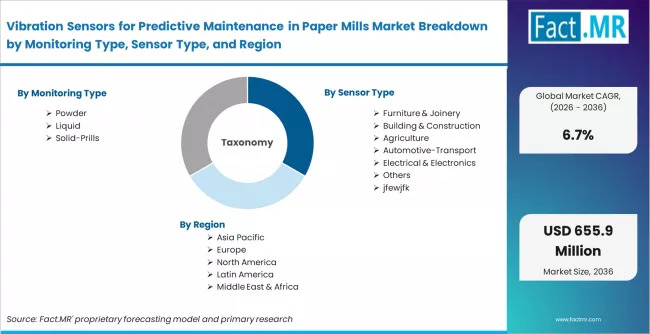
The market is expected to grow at a CAGR of 6.7%, generating an incremental opportunity of USD 291.4 million over the forecast period. This growth reflects a structural transition from reactive and scheduled maintenance toward real-time condition-based monitoring, driven by the need to minimize downtime and enhance operational efficiency across high-speed paper production lines.
Quick Stats
Market Size (2025): USD 298.6 million
Market Size (2026): USD 321.4 million
Forecast Value (2036): USD 612.8 million
CAGR (2026–2036): 6.7%
Incremental Opportunity: USD 291.4 million
Leading Segment: Online Monitoring (46% share)
Leading Region: Europe (with strong UK and Germany adoption)
Key Players: SKF AB, Emerson Electric Co., Siemens AG, ABB Ltd., Hansford Sensors Ltd.
Executive Insight for Decision Makers
A strategic shift toward predictive maintenance ecosystems is redefining industrial reliability standards in paper mills. Decision-makers must prioritize:
Integration of vibration sensors with analytics platforms
Deployment of continuous monitoring systems across critical assets
Upgrading legacy machinery with sensor-based diagnostics
Failure to adopt these technologies risks unplanned downtime, reduced throughput, and higher lifecycle costs, particularly in competitive, high-volume paper production environments.
Market Dynamics
Key Growth Drivers
Increasing adoption of condition-based maintenance systems
Rising need to minimize unplanned downtime in continuous production
Expansion of Industrial IoT (IIoT) architectures
Modernization of legacy paper mill equipment
Key Restraints
High initial cost of industrial-grade sensor systems
Integration challenges with legacy machinery
Dependence on capital expenditure cycles in paper mills
Emerging Trends
Shift toward AI-enabled predictive diagnostics
Growth of wireless sensor networks
Integration with cloud-based maintenance platforms
Adoption of ISO vibration monitoring standards
Segment Analysis
Leading Segment: Online monitoring accounts for 46% share, driven by real-time diagnostics capabilities
Sensor Type Leader: Accelerometers hold 43% share due to high accuracy in vibration detection
Key Applications:
Rollers
Motors
Gearboxes
Fastest-Growing Segment: Wireless and IIoT-enabled sensor systems
Strategic Importance:
Continuous monitoring enables early detection of mechanical anomalies, significantly improving equipment uptime and reducing maintenance costs.
Supply Chain Analysis (Very Important)
Value Chain Structure
Raw Material Suppliers:
Semiconductor components, piezoelectric materials, and industrial-grade enclosures
Manufacturers / Producers:
Companies such as SKF AB and Hansford Sensors Ltd. design and produce vibration sensors
System Integrators / Distributors:
Firms like Siemens AG integrate sensors into broader automation and analytics systems
End-Users:
Pulp and paper manufacturers deploying sensors across rollers, pumps, and drying systems
Who Supplies Whom
Sensor manufacturers supply hardware to automation providers and directly to paper mills, while integrators bundle sensors with predictive analytics platforms. Paper mills increasingly prefer multi-vendor sourcing to reduce dependency and enhance system flexibility.
Pricing Trends
Pricing Model:
Commodity-level sensors for basic monitoring
Premium-priced solutions for integrated analytics and IoT connectivity
Key Influencing Factors:
Raw material costs (electronics and enclosures)
Integration complexity
Certification and industrial standards compliance
Margin Insights:
Higher margins are achieved through value-added services, including analytics software and maintenance platforms rather than standalone hardware.
Regional Analysis
Top Countries by CAGR (2026–2036)
China – 7.6%
India – 7.2%
United Kingdom – 7.0%
Germany – 6.9%
United States – 6.7%
Regional Insights
United Kingdom:
Steady adoption driven by industrial efficiency programs and modernization initiatives
Germany:
Growth supported by Industry 4.0 integration and automation leadership
China & India:
Rapid expansion due to large-scale industrial upgrades and capacity additions
United States:
Mature market driven by replacement demand and advanced analytics adoption
Developed vs Emerging Markets
Developed markets focus on analytics integration and system upgrades
Emerging markets emphasize new installations and digital transformation
Competitive Landscape
Market Structure: Moderately concentrated
Key Players
SKF AB
Emerson Electric Co.
Honeywell International Inc.
ABB Ltd.
Siemens AG
Rockwell Automation Inc.
Parker Hannifin Corporation
Bruel and Kjaer Vibro GmbH
National Instruments Corporation
Hansford Sensors Ltd.
Competitive Strategies
Product innovation in sensor accuracy
Integration with predictive analytics platforms
Strategic partnerships with paper mills
Expansion of global distribution networks
Strategic Takeaways
For Manufacturers
Invest in IIoT-enabled sensor technologies
Enhance integration with analytics platforms
For Investors
Focus on companies offering end-to-end predictive maintenance solutions
Target regions with industrial modernization programs
For Marketers / Distributors
Emphasize ROI through reduced downtime
Build long-term service contracts
Future Outlook
The market is expected to evolve toward fully integrated predictive maintenance ecosystems, combining sensors, AI analytics, and cloud platforms. Sustainability and energy efficiency will further drive adoption, especially in Europe.
Long-term opportunity lies in retrofitting legacy paper mills and expanding sensor deployment across all critical equipment.
Conclusion
The vibration sensors for predictive maintenance in paper mills market is entering a high-value transformation phase, where reliability, efficiency, and digital integration define competitive advantage. Stakeholders who invest in advanced monitoring technologies will secure operational resilience and long-term profitability.
Why This Market Matters
As paper mills operate in high-speed, high-load environments, even minor mechanical failures can disrupt production significantly. Vibration sensors enable early fault detection, cost optimization, and production continuity, making them indispensable in the shift toward smart manufacturing.
Unlock 360° insights for strategic decision making and investment planning:
https://www.factmr.com/checkout/14785
To View Our Related Report:
Handheld Vibration Analyzer Market: https://www.factmr.com/report/handheld-vibration-analyzer-market
Automotive Vibration Absorber Market: https://www.factmr.com/report/507/automotive-vibration-absorber-market
Gas Sensors Market: https://www.factmr.com/report/1966/gas-sensors-market
Tilt Sensors Market: https://www.factmr.com/report/2101/tilt-sensors-market
S. N. Jha
Fact.MR
+1 628-251-1583
email us here
Legal Disclaimer:
EIN Presswire provides this news content “as is” without warranty of any kind. We do not accept any responsibility or liability
for the accuracy, content, images, videos, licenses, completeness, legality, or reliability of the information contained in this
article. If you have any complaints or copyright issues related to this article, kindly contact the author above.

Media gallery